Most founders prepare a deck. Few prepare what matters before the deck opens.
You spent three weeks on your pitch deck. You rehearsed the delivery. You got the intro.
Here’s what we did before your calendar invite even landed: we Googled you.
Then we looked at your LinkedIn activity. Your co-founder’s background. The round history. The cap table. Your last company, if there was one.
This happens in the 20 minutes before the call. It shapes the tone of every question we ask. And most founders have no idea it’s happening.
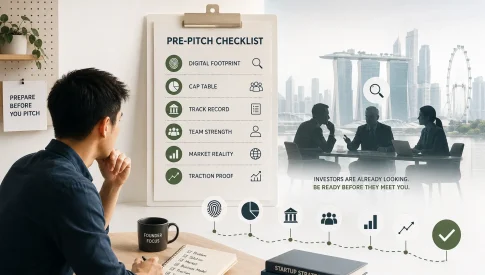
This is the pre-pitch checklist — the one we run silently, before you say hello.
Singapore’s VC ecosystem runs on reputation before revenue. Institutional LPs, family offices, and co-investors all talk. Your story arrives before you do.
1. Your Digital Footprint Has an Opinion
We’re not looking for perfection. We’re looking for a signal. Inconsistent LinkedIn dates, a co-founder who went quiet six months ago, a domain registered last week — these aren’t disqualifiers, but they start the mental clock.
What we want to see: a founder who’s been living this problem for a while. Someone whose online presence tells a coherent story — even if it’s a startup story with bruises.
Fix: Align your narrative. LinkedIn, website, press mentions — they should all read as the same person building the same mission.
2. Your Cap Table Is Already Public
Not literally. But if you’ve done previous rounds, your investors talk to us. We’ll know the structure before you show us the slide. We’re checking for red flags: too many small angels with no lead, unusual dilution, a previous investor who didn’t follow on. That last one quietly kills deals.
Fix: If there’s something awkward on your cap table, address it in the first five minutes. Proactively. VCs respect founders who control their narrative.
3. Your Last Company (or Job) Tells Us How You'll Handle This One
We look at your exit, not just your entry. How did your last company end? If it failed — and many do — how did you treat investors, employees, vendors? Founders think we don’t know. We usually do.
In Singapore’s tightly networked ecosystem, the community remembers. How you handled failure is often more informative than how you handled success.
Fix: Own your history. A founder who can explain a shuttered startup with honesty and self-awareness scores higher than one with a spotless but shallow track record.
4. Team Depth — Or the Absence of It
We’re checking: can this team actually build what they’re describing? In Singapore’s startup funding ecosystem, technical co-founders are harder to find than capital. If you’re a solo non-technical founder pitching a deep-tech product, that’s a real risk we price in.
We also look at team tenure on the current company. If three key hires left in the last year, we’ll ask about it. Quietly, indirectly — but we’ll ask.
Fix: If there are gaps, name them and your plan to fill them. Vague team slides with no faces and roles are worse than honest gaps.
5. The Market You Claim vs. The Market You're Actually In
Every deck says ‘$40 billion addressable market.’ We open a second tab and check. We look at ASEAN-specific data, recent deals in the space, and what the actual competitors — often undisclosed in decks — have raised.
Founders who cite global TAM for what is clearly a Southeast Asia play lose the room. Singapore’s VC community funds precision, not ambition dressed as data.
Fix: Build your TAM from the bottom up. Show us the specific segment you’ll win first, then the path to the bigger number. Sequence matters.
6. Your Traction Is Visible Before You Show the Slide
App stores, ProductHunt, press, LinkedIn mentions, web traffic tools — we check. Not to catch you, but because real traction leaves a trail. If your deck says 10,000 users but Product Hunt never heard of you and your site gets 40 visitors a month, that gap has to be explained.
Fix: Ensure your traction story has public evidence. Even a single well-documented case study beats a slide full of logos we can’t verify.
The Point Isn't to Be Perfect
The point is to not be surprised.
Every item on this checklist is something we’ve seen derail a promising conversation — not because the business was bad, but because the founder walked in blind to how we were reading the room before they arrived.
Raising capital for a startup in Singapore is a process, not a meeting. Your preparation starts weeks before you pitch — and so does ours.
The best founders we’ve backed weren’t the most polished. They were the most honest — about what they had, what they didn’t, and exactly why they were the right people to solve this problem.
Evolve Venture Capital invests in early-stage founders across Southeast Asia. If you’re raising, start by reading the room — before the room reads you.