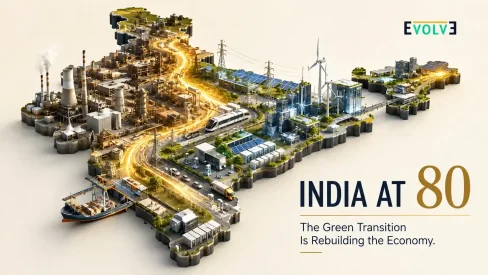
India At 80: How Viksit Bharat’s Green Transition Is Creating The Decade’s Biggest Investment Opportunity

Seventy-nine years after independence, India stands at an inflection point that has no historical parallel: the world’s most populous country, with the world’s third-largest economy, is attempting to decarbonise at a speed and scale that no nation has previously attempted.
The Viksit Bharat 2047 framework — India’s roadmap to its centenary of independence — explicitly integrates green transition as an economic development priority, not an environmental one. For climate investors, this distinction is critical. When clean energy is infrastructure policy, the investment risk profile changes fundamentally.
This piece examines the data behind India’s green transition, the specific investment opportunities it creates, and why Evolve Venture Capital — a Southeast Asia-focused climate tech fund — watches India as closely as any market in our primary investment geography.

India At 80: A Different Economy Than 1947

The economic transformation of 79 years of independence provides the context for understanding why India’s green transition is structurally different from that of any other major economy.
India in 1947 inherited a per-capita income of ₹274 per year, an industrial base oriented toward colonial export, and electricity access below 5% of the population. By 2026, India’s GDP exceeds $4.3 trillion, its per-capita income has grown more than 30-fold in real terms, and electricity access has reached over 99% of households.
That development trajectory created the energy demand that now drives India’s clean transition. India’s electricity consumption has grown at an average of 6.5% per year over the past decade. Meeting that demand growth with clean rather than fossil energy — while simultaneously replacing existing fossil generation — is the core engineering and financial challenge of India’s green transition.
The challenge is real. So is the investment opportunity it creates.

The 500GW Target: What the Numbers Actually Mean
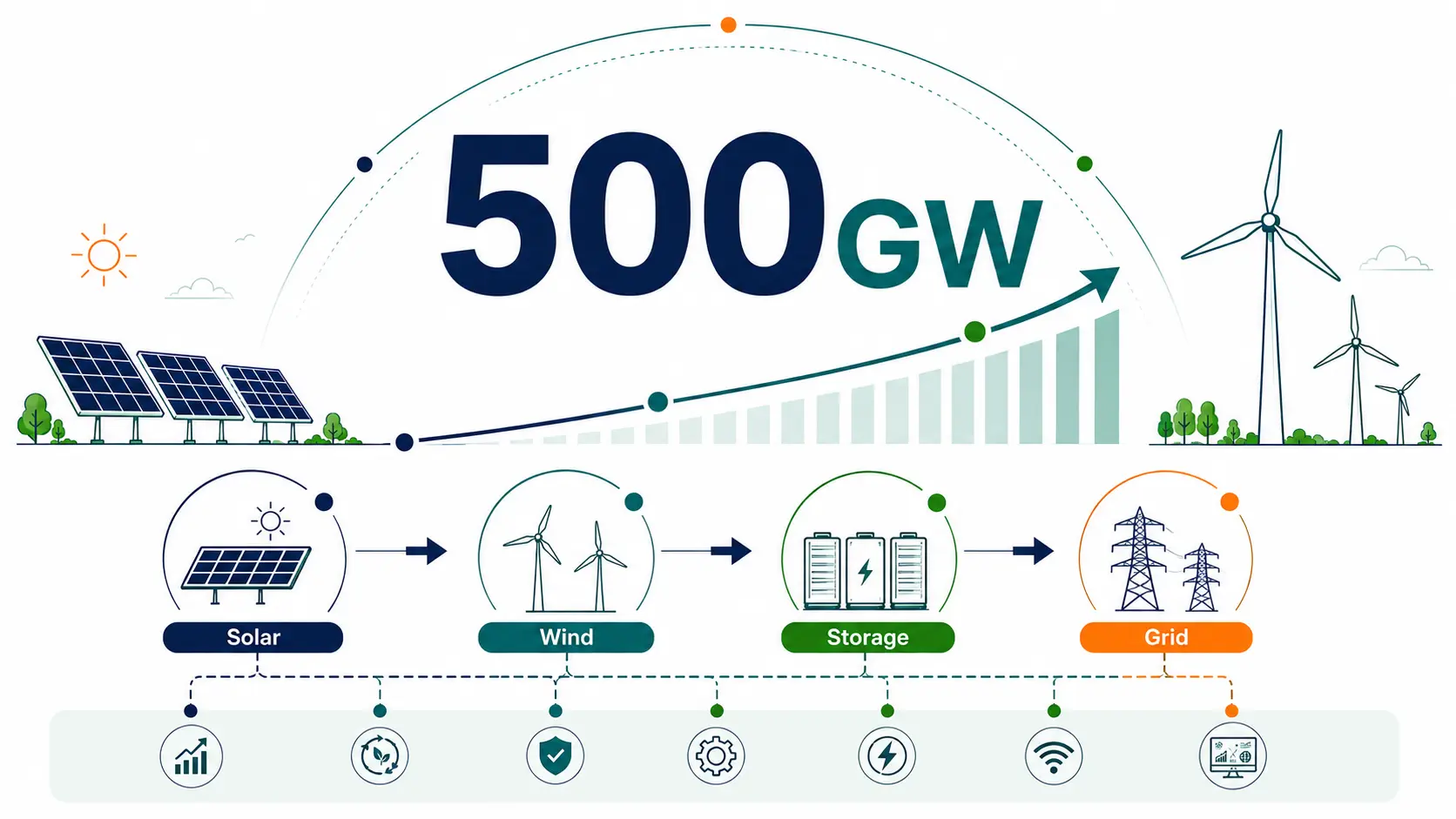
India’s commitment to 500GW of installed renewable energy capacity by 2030 is the centrepiece of its climate finance story. Understanding what that number means in practice requires moving beyond the headline.
Present Position of India: Till mid-2026, India has surpassed its 220GW mark for its cumulative capacity of renewable energy generation. Out of which 140 GW comes from solar sources and 47 GW is generated through wind power.
500 GW needs:The difference between 220 GW and 500 GW is 280 GW, to be added in about four years’ time. This will need an addition of about 56–70 GW per year, which India has not been able to achieve till date but 2025 witnessed about 38 GW being added, which is its best performance ever.
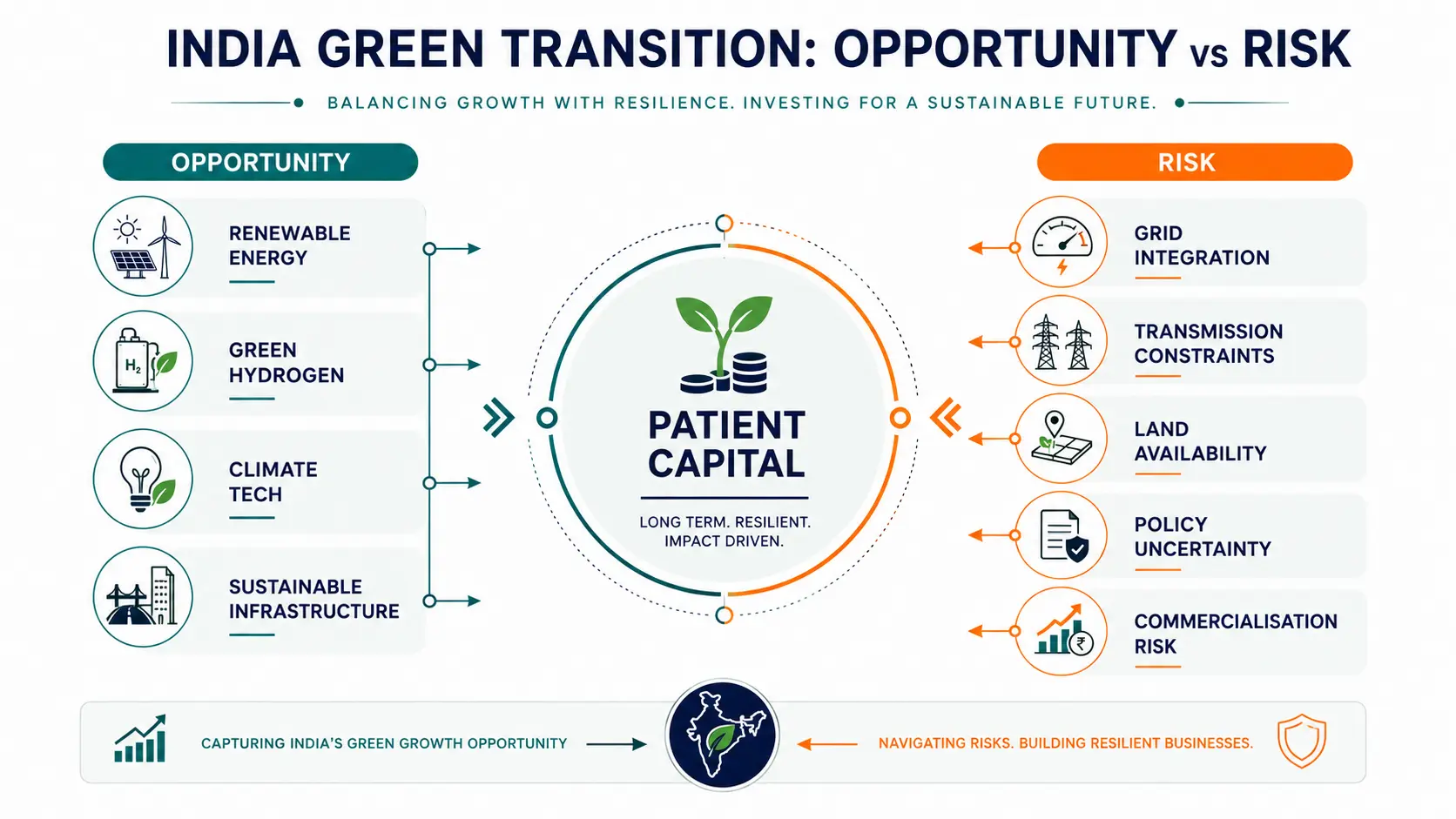
The transmission constraint: Renewable energy capacity alone does not equal renewable energy delivery. The transmission infrastructure required to carry solar and wind electricity from generation-rich states — Rajasthan, Gujarat, Tamil Nadu — to high-demand centres in Maharashtra, Uttar Pradesh, and West Bengal requires an estimated $50–80 billion in transmission investment that is not yet fully committed or contracted.
The storage constraint: Variable renewable energy requires storage to be dispatchable. The capacity for battery storage in India as of mid-2026 comes to roughly 4GW, which is a mere fraction of what is needed to accommodate the intermittent energy generation of 500GW. While there has been rapid battery storage deployment, more still needs to be done.
The investment implication: The 500GW target creates investment opportunity not just in solar and wind generation, but in the entire enabling stack: transmission infrastructure, grid-scale storage, flexible load management, smart grid technology, and the digital systems that manage real-time grid balancing. Each of these categories represents a distinct climate investment vertical directly enabled by the 500GW commitment.

Viksit Bharat 2047: The Investment Framework

The Viksit Bharat framework is India’s most ambitious policy commitment since liberalisation in 1991. It is a comprehensive development blueprint targeting India’s centenary of independence — and it places green transition at the centre of the economic development agenda.
For climate investors, the most significant aspect of Viksit Bharat is not its environmental ambition. It is its structural integration of clean energy with economic competitiveness.
Solar Villages: The scheme to ensure that 100% of the electricity comes from renewable sources in rural villages is one of the infrastructure schemes but with climate finance features. It generates demand for decentralized solar energy, battery storage and energy management systems at the village level – a huge market which is currently underserved.
Industrial Decarbonisation Mandate: Viksit Bharat’s manufacturing competitiveness pillar includes explicit targets for MSME energy decarbonisation. India has approximately 63 million MSMEs, accounting for roughly 45% of industrial energy consumption. Decarbonising that base is a capital deployment opportunity of extraordinary scale.
EV Transition: India’s EV adoption trajectory — led by two-wheelers and three-wheelers, followed by commercial fleets and passenger vehicles — creates demand for charging infrastructure, battery manufacturing, and grid management technology that extends the clean energy investment universe well beyond power generation.
The Capital Gap: Credible estimates of India’s annual climate investment requirement through 2030 range from $150 to $170 billion per year. Current annual climate-related investment in India runs at approximately $50–60 billion. The gap — $90–110 billion per year — represents the structural market opportunity that Viksit Bharat is designed to catalyse private capital into filling.

Green Hydrogen: India's Decade-Defining Wildcard

India’s National Green Hydrogen Mission is one of the most significant single government commitments to green hydrogen technology in the world.
The commitment: ₹19,744 Crore (approximately $2.4 billion) in production-linked incentives, demand creation mandates, and electrolyser manufacturing support.
The target: 5 million tonnes per year of domestic green hydrogen production by 2030, with an initial mandate requiring fertiliser producers and petroleum refineries to blend green hydrogen into their processes.
The manufacturing play: India is building electrolyser manufacturing capacity in Rajasthan and Gujarat, supported by Production Linked Incentives designed to make India a net exporter of electrolyser technology by 2027. This is the same industrial policy playbook that made India a major solar module manufacturer — and it has a credible chance of working for electrolysers.
The cost trajectory: India’s combination of cheap renewable electricity (among the lowest solar LCOE globally) and improving electrolyser costs creates a pathway to green hydrogen production at approximately $1.50 per kilogram by 2030. At that cost level, Indian green hydrogen is competitive with grey hydrogen at current fossil gas prices without subsidy — a genuine commercialisation milestone.
The investment opportunity: Green hydrogen creates a decarbonisation pathway for hard-to-abate sectors that have no other viable clean alternative at scale — steel, cement, fertiliser, shipping, aviation fuel. Each of these sectors represents a market that commercial-scale green hydrogen unlocks, and each unlocked market creates investment opportunity for the climate capital that funds the technology and infrastructure stack.

Why Southeast Asia-Focused Evolve Venture Capital Watches India
Evolve Venture Capital’s primary investment mandate covers Southeast Asia — Indonesia, Vietnam, Thailand, the Philippines, Malaysia, and Singapore. India is not our primary market.
We watch India closely for a specific and investment-relevant reason: the technology transfer corridor between India and ASEAN is real, active, and accelerating.
The climate challenges that India is solving at scale — agricultural carbon monitoring for smallholder farmers, industrial heat electrification for MSME manufacturers, distributed renewable energy for rural communities, satellite-based MRV for tropical forest carbon — are structurally identical to the challenges facing comparable markets in Southeast Asia.
India’s agricultural structure closely mirrors Indonesia’s and Vietnam’s. India’s MSME manufacturing base is comparable to Thailand’s and the Philippines’. The climate vulnerability profile — extreme heat, monsoon disruption, coastal flooding — maps almost exactly onto the ASEAN experience.
The founders who have built and proven climate tech solutions at scale in India are, with increasing frequency, the founders bringing those solutions to Southeast Asia. We are seeing this pattern in our deal flow, in our portfolio, and in the accelerator ecosystems across the region.
For Evolve Venture Capital, India is a technology proving ground, a talent source, and an increasingly important co-investment context. The climate tech playbook being written in Gujarat and Andhra Pradesh will be deployed in Java and the Mekong Delta.

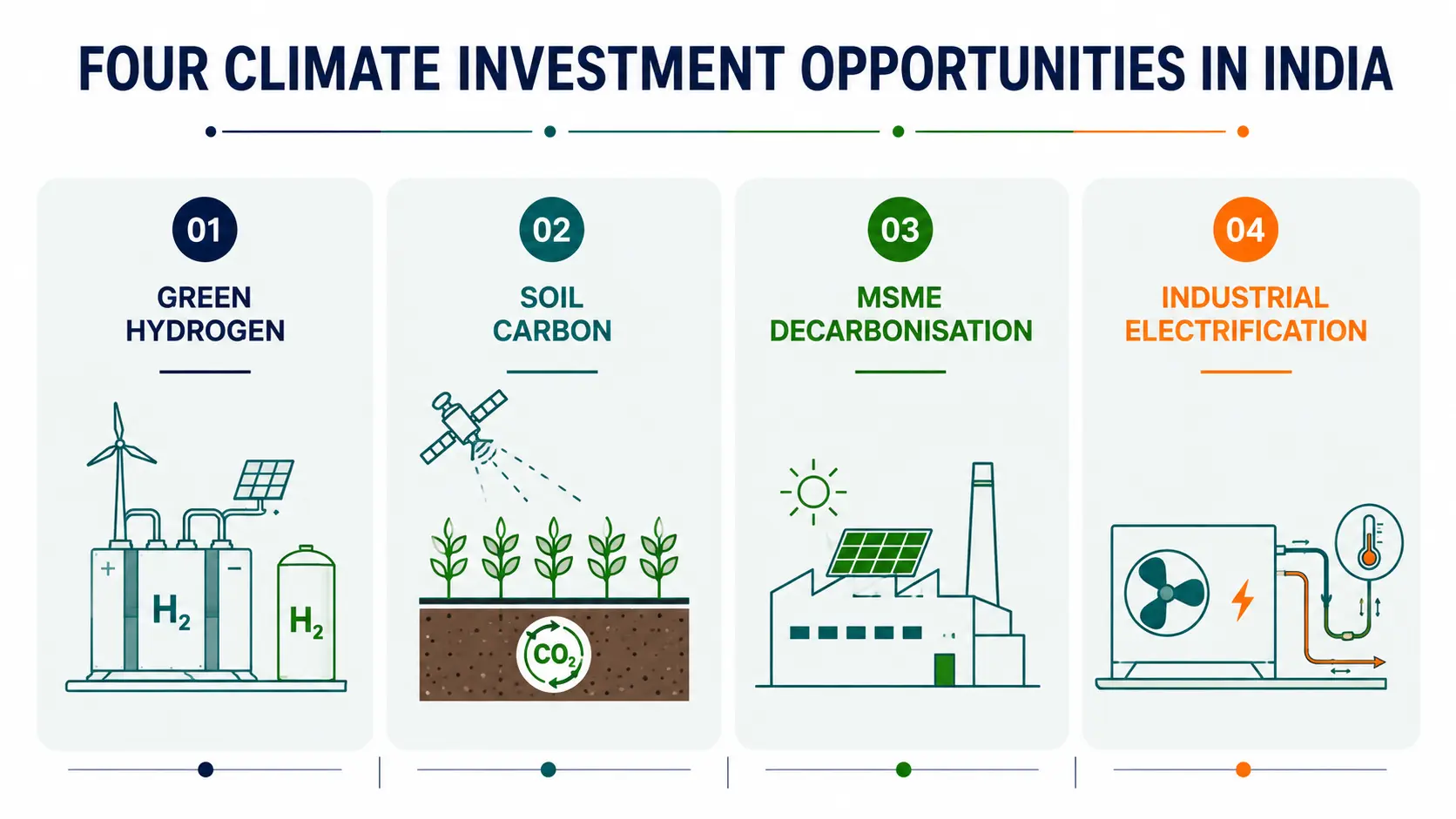
The Four Investment Opportunities We're Watching in 2026

1. Green Hydrogen Infrastructure — Co-Investment With DFIs
The capital stack for green hydrogen production facilities in India is beginning to coalesce around a blended finance structure: government PLI as the first layer, DFI concessional debt (IFC, ADB, AIIB) as the second, and commercial equity from patient capital funds as the third.
This structure de-risks the early capital with government support and concessional terms, creates a clear return path for commercial investors, and enables the longer hold period that green hydrogen commercialisation requires.
2. Agricultural Soil Carbon — Satellite MRV at Scale
India has approximately 140 million smallholder farming households. The transition to regenerative agricultural practices — reduced tillage, cover cropping, soil amendment — generates measurable soil carbon sequestration that can be sold as carbon credits under high-integrity MRV frameworks.
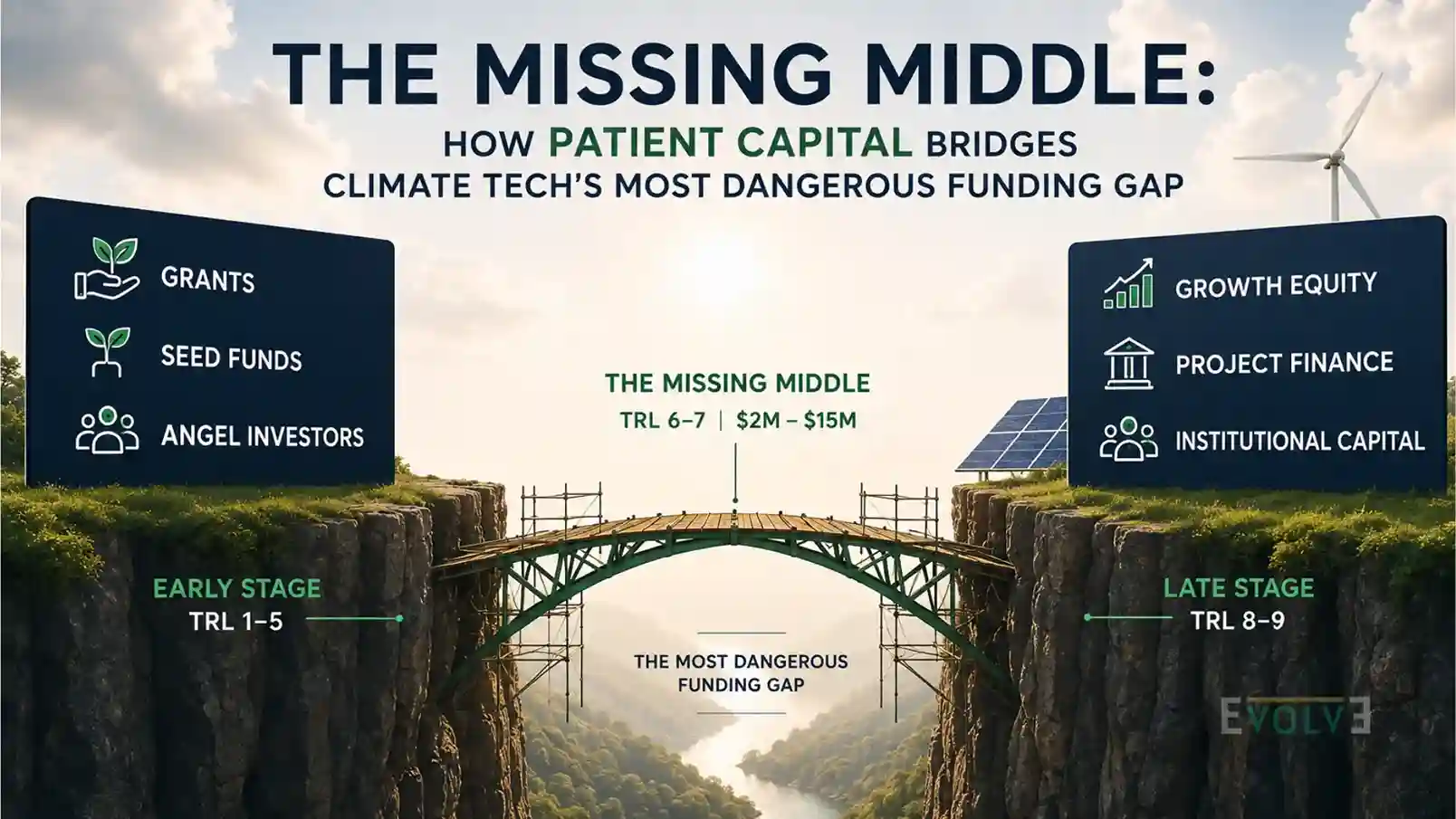
The technology to monitor, measure, and verify agricultural soil carbon using satellite imagery, machine learning, and IoT soil sensors is reaching TRL 6–7 in India. The commercial model is proving viable in pilots across Maharashtra and Madhya Pradesh. The next step is commercial-scale deployment that patient capital is designed to fund.
3. MSME Energy Decarbonisation
India’s 63 million MSMEs consume energy at a scale that makes their decarbonisation both enormously impactful and commercially attractive. The market for energy-as-a-service offerings — solar rooftop, industrial heat electrification, energy efficiency retrofits — that serve MSME manufacturers without requiring large upfront capital is large, growing, and underserved by current climate capital.
The business model (pay-as-you-save, energy service company structures) has been proven at small scale. Expansion to commercial scale requires patient equity that can hold through the three-to-five year customer acquisition and deployment cycle.
4. Industrial Heat Electrification
Approximately 20% of India’s industrial energy demand is heat below 300°C — process heat for food processing, textile dyeing, chemical manufacturing, ceramic kilns. This heat is currently produced almost entirely by fossil fuels. Electrification using electric boilers, heat pumps, and thermal storage is technically proven and increasingly cost-competitive.
The missing piece is patient capital willing to fund commercial-scale deployment of industrial heat electrification technology in Indian MSME clusters — proving the model at scale before growth equity arrives.
These opportunities reflect the broader range of sustainable investment opportunities emerging across climate technology and energy transition markets.

The Honest Investment Assessment

India’s green transition is one of the most compelling climate investment opportunities of this decade. It is also one of the most complex to execute.
The risks are real. Grid integration at 500GW has not been solved. Transmission infrastructure investment is behind schedule. Land acquisition for large renewable installations moves slowly. Policy continuity across state governments is uneven. Green hydrogen at $1.50/kg by 2030 is achievable but carries execution risk.
The opportunities are equally real. The market need is existential. The policy commitment is backed by significant government capital. Technology readiness at TRL 6–8 across multiple verticals is higher than at any previous point. The founder quality in Indian climate tech is exceptional.
The investment structure that matches this opportunity is patient capital with a long enough hold period to move through the commercialisation cycle — and the operational involvement to help portfolio companies navigate the complexity of the Indian regulatory and market environment.
That is exactly the structure Evolve Venture Capital was built to deploy.

Frequently Asked Questions

How much is India investing in renewable energy by 2030?

India’s 500GW target requires an estimated $150–170 billion per year in climate-related investment through 2030. Current annual investment stands at approximately $50–60 billion, creating a gap of $90–110 billion per year that represents the primary market opportunity for climate capital in India.

What is the green transition target for Viksit Bharat 2047?

Viksit Bharat 2047 is India’s national development roadmap to its centenary of independence. Its green transition pillar covers renewable energy deployment to 500GW by 2030, MSME decarbonisation, EV adoption, and the Solar Villages programme — all framed as economic infrastructure investment rather than environmental policy.

What is the investment potential of green hydrogen in India?

India’s National Green Hydrogen Mission is making a capital investment of ₹19,744 Crore (~$2.4 billion). The market potential of green hydrogen in hard-to-abate sectors like steel, fertilizers, cement, and shipping is estimated to be worth $8-$12 billion per year by 2030.

Why is India’s 500GW renewable target important for climate investors?

The 500GW target creates investment opportunity not just in generation, but in the enabling infrastructure: transmission, grid-scale storage, flexible load management, and digital grid technology. Each vertical is a distinct capital deployment opportunity directly enabled by the policy commitment.

How does India’s climate transition relate to Southeast Asia?

India and Southeast Asia both have similar structures in agriculture, manufacturing through MSMEs, and vulnerabilities to climate change. The technologies that have worked successfully in India in terms of satellite MRV, industrial heat electrification, and distributed renewable energy can be easily used in ASEAN countries as well.

Sources

  1. Ministry of New and Renewable Energy (MNRE) — Renewable Energy Installed Capacity, Mid-2026 https://mnre.gov.in/the-ministry/annual-report
  2. National Green Hydrogen Mission — Official Programme Document and PLI Framework https://mnre.gov.in/green-hydrogen
  3. IEA — India Energy Outlook 2025 https://www.iea.org/reports/india-energy-outlook-2025
  4. Evolve Venture Capital — Internal Market Analysis 2025–2026 https://evolvevcap.com

Most Recent Posts

  • All Post
  • Blogs
  • Climate Tech Investing
  • Industry Reports
  • Whitepapers
    •   Back
    • Investment Strategies
    • Funding Processes
    • Market Research
    • Emerging Sectors
    • Risk Analysis
    • Portfolio Management
    •   Back
    • Funding Insights
    • Market Trends
    • Growth Strategies
    • Investor Tips
    • Financial Planning
    • Leadership Advice
    • Sustainable Tech Insights
    •   Back
    • Global Trends
    • Sector Insights
    • Regional Markets
    • Funding Analysis
    • Innovation Reports
    • Investor Behavior