The Phone Call Nobody Returns
Mira had spent four years building a biochar carbon removal system for smallholder farms in Central Java. By 2025, her technology worked. Not in a lab — in the field, across 14 farming cooperatives, with independently verified carbon sequestration data and an MRV audit that passed first review.
She had TRL 6. She had proof. She had a pathway to 300 additional cooperatives within 18 months if she could raise $4 million.
She couldn’t.
Not because the technology was unproven. Not because the market wasn’t real. Not because the team was weak.
She couldn’t raise because she was standing in the gap. Too commercially advanced for most climate grants and seed funds. Too early and too capital-intensive for growth equity and institutional PE. In precisely the moment her company needed bridge capital the most, the bridge didn’t exist.
In climate finance, this gap has a name: the missing middle.
And it is the single most dangerous place for a climate tech company to stand.
What Is The Missing Middle?
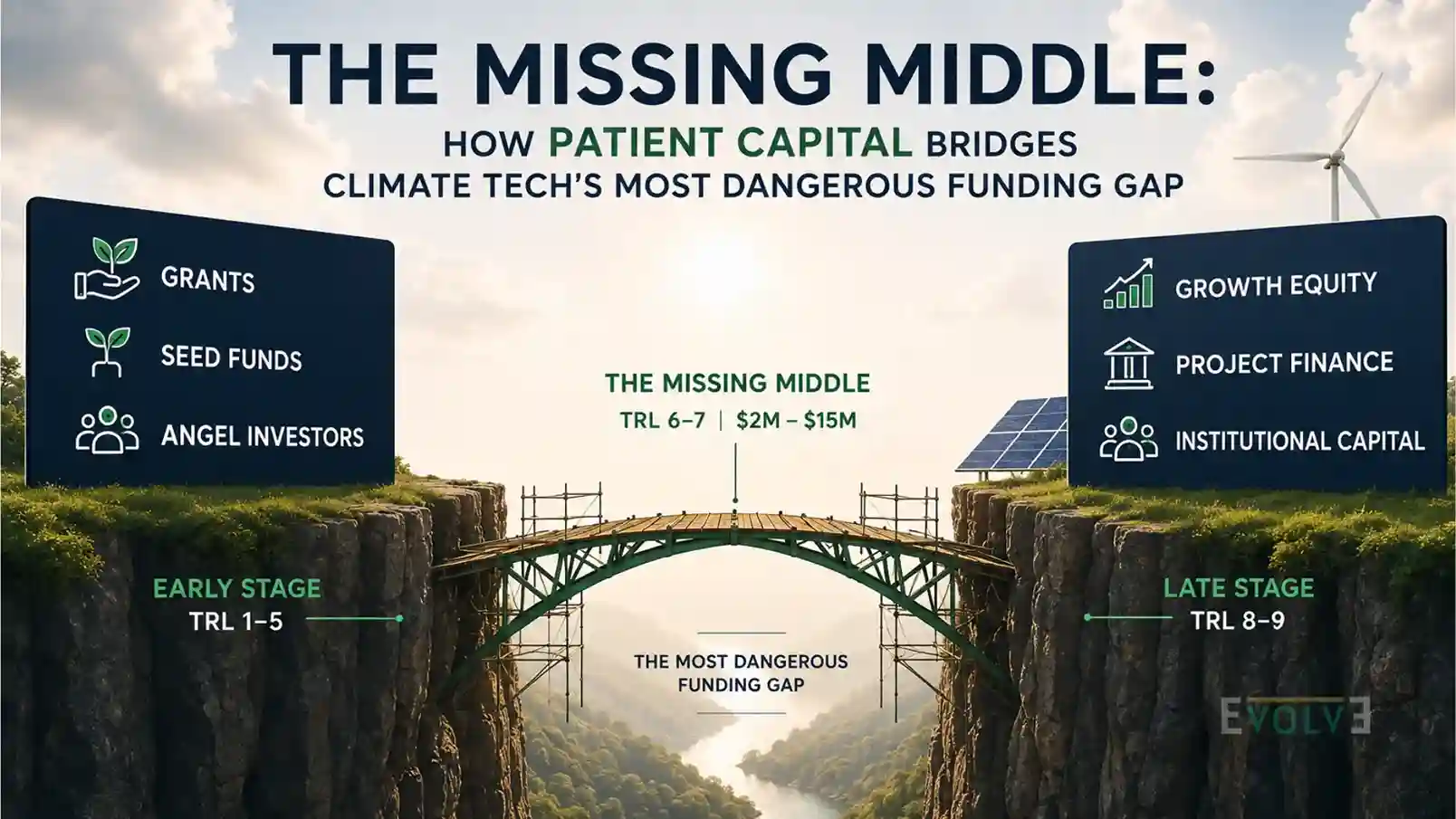
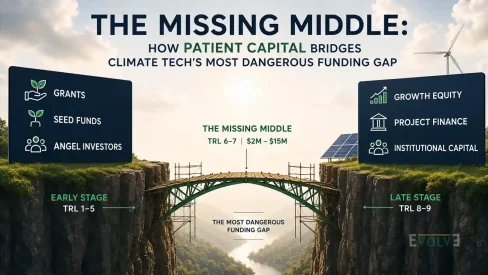
The missing middle is the funding gap that exists between a climate technology’s successful proof-of-concept and its first commercially viable deployment at scale.
It typically sits between approximately $2 million and $15 million in total capital requirement — the range where a company has validated its technology, demonstrated real-world impact, and identified a clear path to commercial revenue, but hasn’t yet built the revenue track record or asset base that growth equity and institutional capital require.
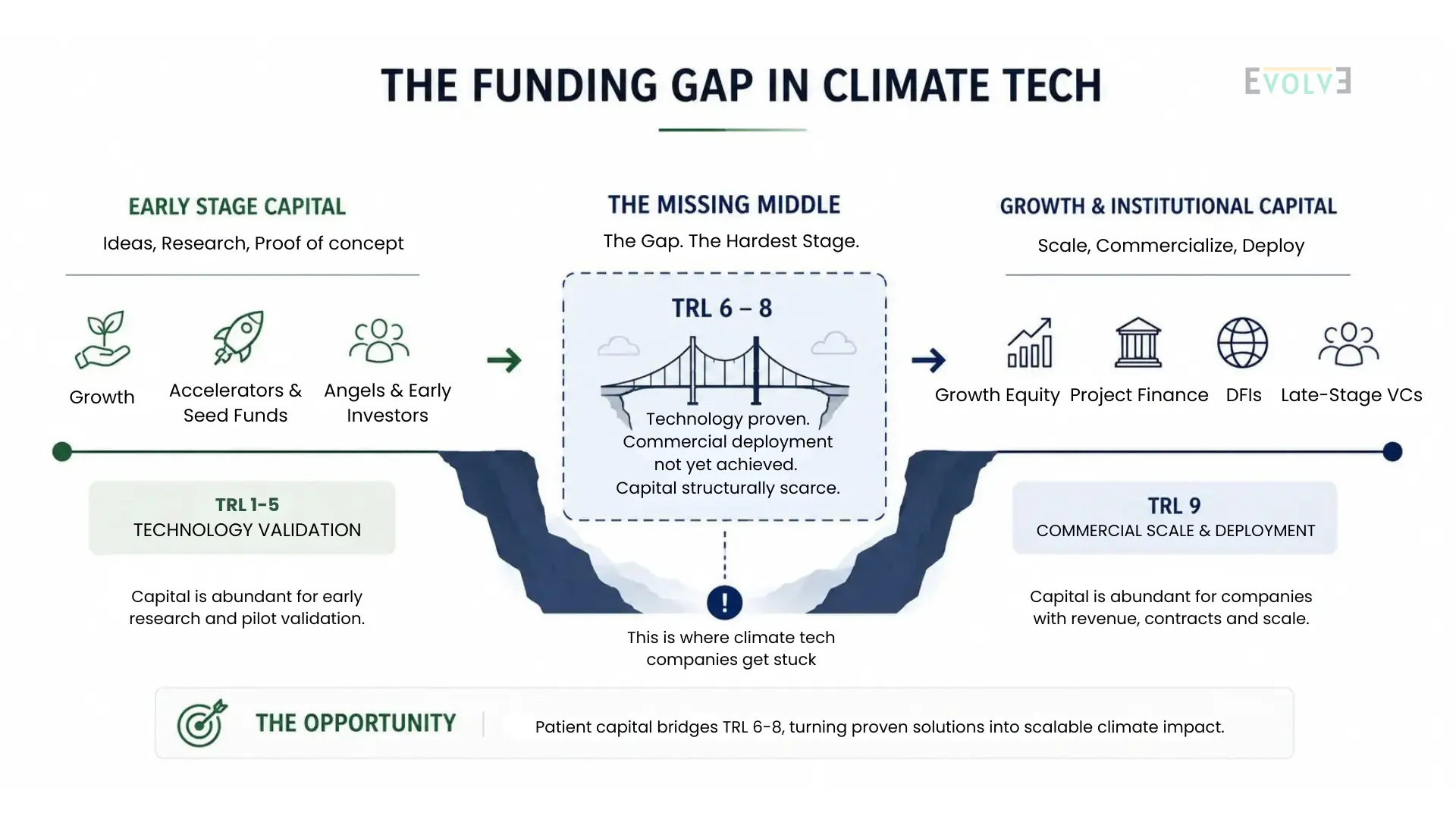
On one side of the gap: grants, climate accelerators, angel investors, and early-stage impact funds. These players are comfortable funding technology validation getting a solution from concept (TRL 1) to proven pilot (TRL 5 or 6). This capital is abundant relative to the stage it serves.
On the other side: growth equity funds, project finance vehicles, development finance institutions, and late-stage climate VCs. These players want commercial proof — revenue, contracts, audited financials, enterprise customers. They fund from commercial deployment (TRL 8-9) onward. This capital is also abundant.
In the middle: TRL 6, 7, and the early phase of TRL 8. Technology proven at pilot scale. Commercial deployment not yet achieved. Revenue real but not yet scaled. This is where capital is genuinely, structurally scarce.
The missing middle is not a funding problem in the traditional sense. The capital exists. The issue is that the risk-return profile of a company in the missing middle fits nobody’s mandate cleanly — and so everybody passes.
Why The Funding Gap Exists: A Structural Problem, Not A Market Failure
Understanding why the missing middle exists requires understanding how different capital pools are structured — and why those structures systematically exclude the companies that need capital most.
The Early-Stage Problem
Climate grants and seed funds are structured to fund exploration and validation. Their success metric is technological proof — demonstrating that an idea works. Once a company has proven the technology at pilot scale and is ready to move toward commercialisation, it has typically outgrown what seed capital is designed to fund. Seed investors who came in at TRL 3 or 4 are looking for their next deal, not a larger follow-on at TRL 6.
The Growth-Stage Problem
Growth equity and institutional capital are structured around financial risk, not technology risk. They need to model cash flows, underwrite revenue growth, and price the investment based on comparable commercial transactions. A climate tech company at TRL 6 or early TRL 7 has technology proof but limited financial history. It can’t be underwritten on DCF. It doesn’t fit comfortably into the financial risk frameworks that growth capital uses. And because climate tech commercialisation timelines are longer than most sectors, the exit horizon required doesn’t match the 3-5 year return cycle that most growth funds target.
The Result
According to a 2025 survey by the Global Innovation Lab for Climate Finance, 51% of active climate investors identified the pilot-to-scale gap as the number one bottleneck to climate tech deployment globally. Not technology readiness. Not policy uncertainty. Not market demand. The gap between the capital that funds proof and the capital that funds scale.
The companies in this gap are not failing companies. They are, in many cases, the most important companies in the climate tech ecosystem — the ones that have already done the hard work of validation and are ready to generate real-world impact at scale if capital is available.
Most of the time, it isn’t.
The Southeast Asia Dimension
The missing middle problem exists globally, but it is acutely severe in Southeast Asia — and for reasons that compound in ways that don’t apply to European or North American climate tech ecosystems.
Smaller average deal sizes. Southeast Asian climate tech companies raising $3–8 million — squarely in the missing middle range — represent a deal size that many global climate funds are structurally unable to deploy into efficiently. A $500 million fund cannot justify the due diligence and portfolio management overhead of a $4 million investment. The math doesn’t work. So deals that would easily find capital in larger markets go unfunded in SEA simply because they’re too small for the funds that could theoretically back them.
Thinner local capital markets. The Southeast Asian institutional investor landscape for climate tech is still developing. Local pension funds, family offices, and endowments that back climate tech in the US or Europe are less active in the region. The density of capital willing to play in the missing middle is lower, making the gap proportionally wider.
Higher perceived risk. International capital often perceives Southeast Asian markets as carrying additional regulatory, currency, and operational risk — even when the underlying climate technology is equivalent to comparable European or North American solutions. This risk perception compression pushes institutional investors further toward the safer end of the TRL spectrum, deepening the middle gap.
The data tells the story. Between 2018 and June 2026, Southeast Asia attracted approximately $1.1 billion in total climate tech investment. The United States attracted more than that in a single quarter of 2025. The regional funding deficit is real — and it is most severe precisely in the missing middle range where commercial-scale climate solutions need capital to deploy.
What Patient Capital Does Differently
Patient capital is not simply “slow capital.” It is capital structured specifically to match the investment timeline that climate tech commercialization actually requires — as opposed to the timeline that fund economics prefer.
The structural differences matter in concrete ways.
Longer hold periods. Standard venture capital holds for 5 to 7 years. Private equity holds for 3 to 5. A climate tech company moving from TRL 6 to full commercial deployment in Southeast Asia typically needs 7 to 10 years. Patient capital funds with 9 to 12 year structures can hold through that full journey without the artificial pressure to seek exits before the company is ready.
Different return benchmarks. Because patient capital accepts longer hold periods, it can target return profiles that reflect the actual risk-adjusted economics of climate tech — rather than the compressed multiples that shorter-horizon funds require to compensate for their timeline constraints. Evolve Venture Capital targets 3.4x MOIC over a 7-9 year hold. The industry benchmark for comparable-stage climate tech is 1.1x. The difference is not due to superior deal selection alone — it’s the direct result of not being forced to exit too early.
Active commercialisation support. Patient capital investors who specialise in the missing middle don’t just provide capital. They provide the bridge-building that companies at TRL 6-8 actually need: introductions to enterprise customers, government partnership frameworks, market access, regulatory navigation, and strategic positioning for the next capital raise. This operational involvement is viable because the investor is planning to be in the company for 7-9 years — long enough for that involvement to generate return.
Verification-first underwriting. Missing middle investments require a different due diligence approach than either seed or growth investing. The technology is proven — but is the impact claim independently verified? Is the path to commercial deployment clearly mapped? Are the regulatory conditions stable? Patient capital investors invest the time in verification because they’re holding long enough to be affected by what the verification reveals.
The TRL Framework: Where Evolve Venture Capital Deploys Capital
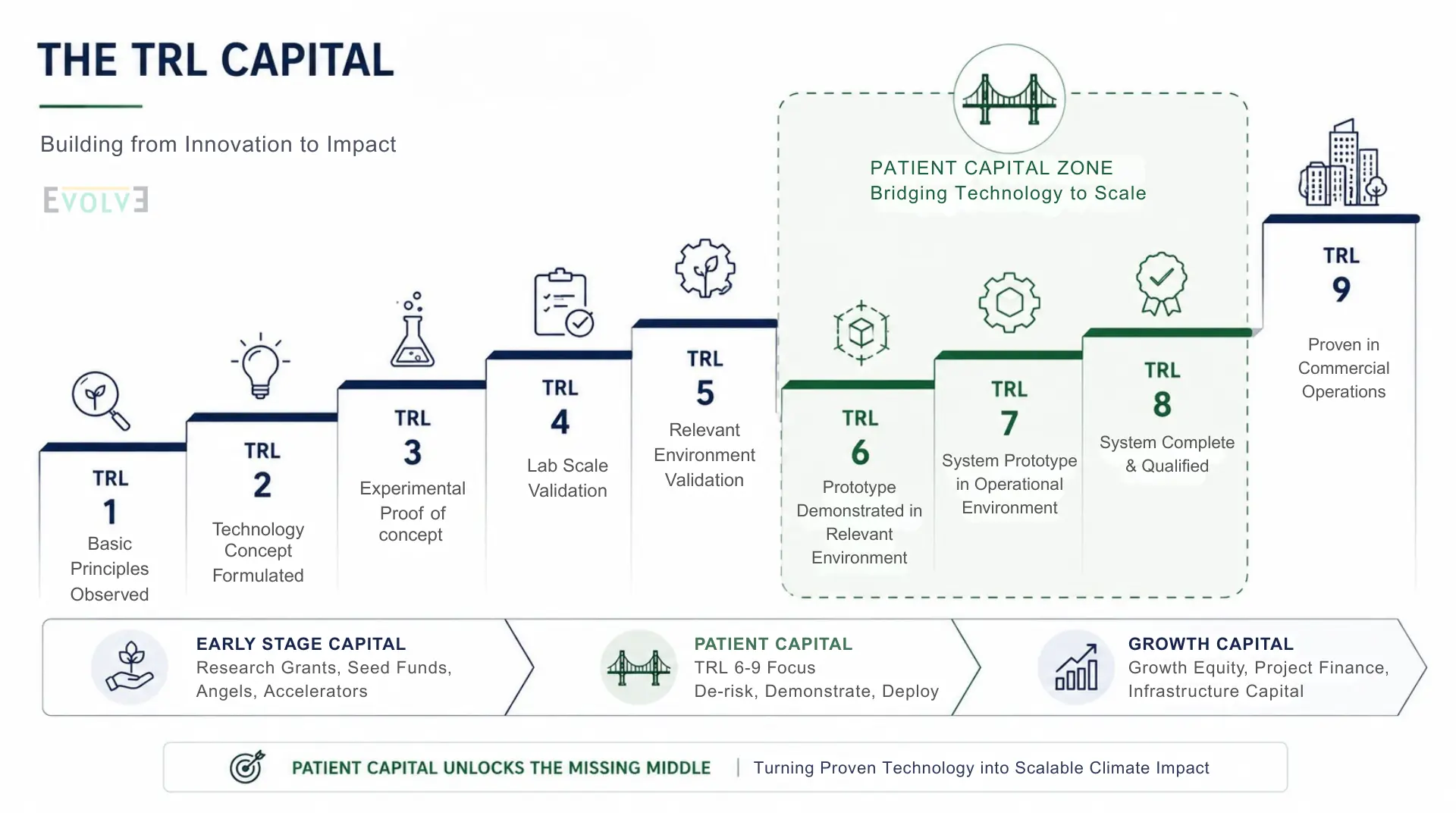
At Evolve Venture Capital, we use the Technology Readiness Level (TRL) framework — originally developed by NASA and now widely adopted in climate tech — as the primary lens for evaluating investment readiness.
The nine levels break roughly into three phases:
- TRL 1–5: Research and validation. Concept, lab testing, simulation, and small-scale prototype. Funded through grants through research and development investment and, through seed capital.
- TRL 6–8: The missing middle. Demonstration at scale, prototype in operational environment, system complete and qualified. This is where Evolve Venture Capital invests.
- TRL 9: Commercial deployment. Full commercial application proven. Funded by growth equity, project finance, and institutional capital.
Evolve Venture Capital’s mandate is TRL 6 entry with a commitment to support portfolio companies through TRL 9. We deploy capital at the moment the technology has been proven in a real-world operational environment — after the seed risk has been eliminated, before the commercial proof that growth investors require.
This means we invest after the hardest technical uncertainty has been resolved, but before the hardest commercial proof has been built. We hold through the commercialisation journey. We exit when the company is at the stage where institutional capital can enter at scale.
This is not a gap-filling strategy. It is a deliberate return strategy — because the missing middle, precisely because it is avoided by most capital, is where the most compelling risk-adjusted returns in climate tech exist.
The Companies That Fall Through
The companies in the missing middle are not startup stories. They are not experiments. They are solutions that work — validated by data, verified by independent auditors, and ready to generate real climate impact at scale if capital is available to bridge the commercial gap.
The biochar company in Java. The distributed solar platform in Vietnam that passed its first utility procurement contract but couldn’t fund inventory. The methane capture system in the Philippines that had signed government letters of intent but couldn’t raise the $6 million needed to build the first three commercial installations.
These are not failed companies. They are companies that fell through the gap.
The cost of that gap is not just financial. Every company that fails to cross the missing middle is a climate solution that doesn’t deploy. Every megawatt of renewable energy that doesn’t get built. Every tonne of carbon that isn’t sequestered. Every farmer who doesn’t get paid for sustainable land management.
The missing middle is not just a capital markets problem. It is, very directly, a climate problem.
Closing The Gap: What Needs To Change
Structural solutions to the missing middle require action at multiple levels — and some of that action is already happening.
Development finance institutions are beginning to create first-loss facilities that reduce the perceived risk for commercial capital entering the missing middle. Blended finance structures — combining concessional capital from DFIs with commercial capital from impact funds — are starting to appear in Southeast Asia in ways that lower the effective risk floor for patient capital investors.
Government procurement commitments — like Indonesia’s biofuel mandates and Vietnam’s offshore wind targets — create demand certainty that makes commercial-stage climate tech more fundable. When a company has a credible government offtake agreement, the missing middle narrows.
And an increasing number of institutional investors — family offices, endowments, and sovereign wealth funds — are beginning to recognize that the missing middle represents a return opportunity, not just a philanthropic obligation. The financial logic is becoming clear: patient capital deployed in the missing middle, at the right TRL with the right verification framework, generates returns that more conventional climate tech strategies cannot match.
What Founders In The Missing Middle Should Know
If you are building a climate tech company in Southeast Asia and you are currently at TRL 6 or above, the most important thing to understand is that the gap you’re facing is structural, not personal.
The capital that should exist at your stage doesn’t yet exist at scale. But it is growing — and the investors who are building it are looking for exactly the companies that most conventional VCs have passed on.
What patient capital investors want to see at TRL 6:
- Independent MRV verification of your impact claims — not internal data, not projections, but independently audited results
- A clear TRL 7 and TRL 8 roadmap — not just technology development, but the specific commercial milestones that define your path to deployment
- At least one verified commercial signal — a signed LOI, a government MOU, or a paying pilot customer
- An exit thesis that matches patient capital timelines — if your plan requires a growth equity exit in year 3, patient capital is not the right fit
The missing middle is the hardest place to raise. It is also the place where the most important climate solutions live. The capital to fund those solutions is coming — and for the companies that can demonstrate verified progress at TRL6, opportunities to raise capital are available now.
Frequently Asked Questions
What is the “missing middle” in climate tech?
The missing middle is the funding gap between early-stage validation (grants, seed) and commercial-scale deployment (growth equity, project finance). It typically covers companies at TRL 6–8 — where technology is proven but commercial revenue is not yet established.
Why is the missing middle a problem in Southeast Asia specifically?
Southeast Asia has smaller average deal sizes, thinner local capital markets, and higher perceived risk from international investors — all of which make the missing middle gap wider and deeper than in more developed climate tech markets like the US or Europe.
What is TRL 6 in climate tech?
TRL 6 means a technology prototype has been demonstrated in a relevant operational environment — real-world conditions, not just a lab. It is the point where the core technology risk is substantially resolved but commercial deployment has not yet been achieved.
How does patient capital differ from standard venture capital?
Patient capital has longer fund lifespans (9–12 years vs 7–10), longer planned hold periods (7–9 years vs 3–5), and return targets calibrated to match the actual commercialisation timeline of the businesses it funds — rather than compressed to fit the fund’s exit pressure.
What returns does patient capital generate in climate tech?
Evolve Venture Capital targets 3.4x MOIC over a 7–9 year hold period, compared to an industry benchmark of 1.1x for comparable-stage climate tech. The difference reflects the return opportunity available when capital is patient enough to hold through commercialisation rather than exiting at an artificially early stage.
Sources
- Global Innovation Lab for Climate Finance — 2025 Annual Survey: Barriers to Climate Tech Scale-Up — https://climatefinancelab.org
- NASA — Technology Readiness Level (TRL) Framework — https://www.nasa.gov/directorates/somd/space-communications-navigation-program/technology-readiness-levels
- Evolve Venture Capital — Internal Portfolio & Deal Flow Data 2025–2026 — https://evolvevcap.com
Evolve Venture Capital is a Southeast Asia climate tech fund deploying patient capital at TRL 6 and above. We invest in the missing middle — the companies that have already done the hard work and need capital to close the commercial gap. If you are building in climate tech and are between seed and scale, we want to hear from you.