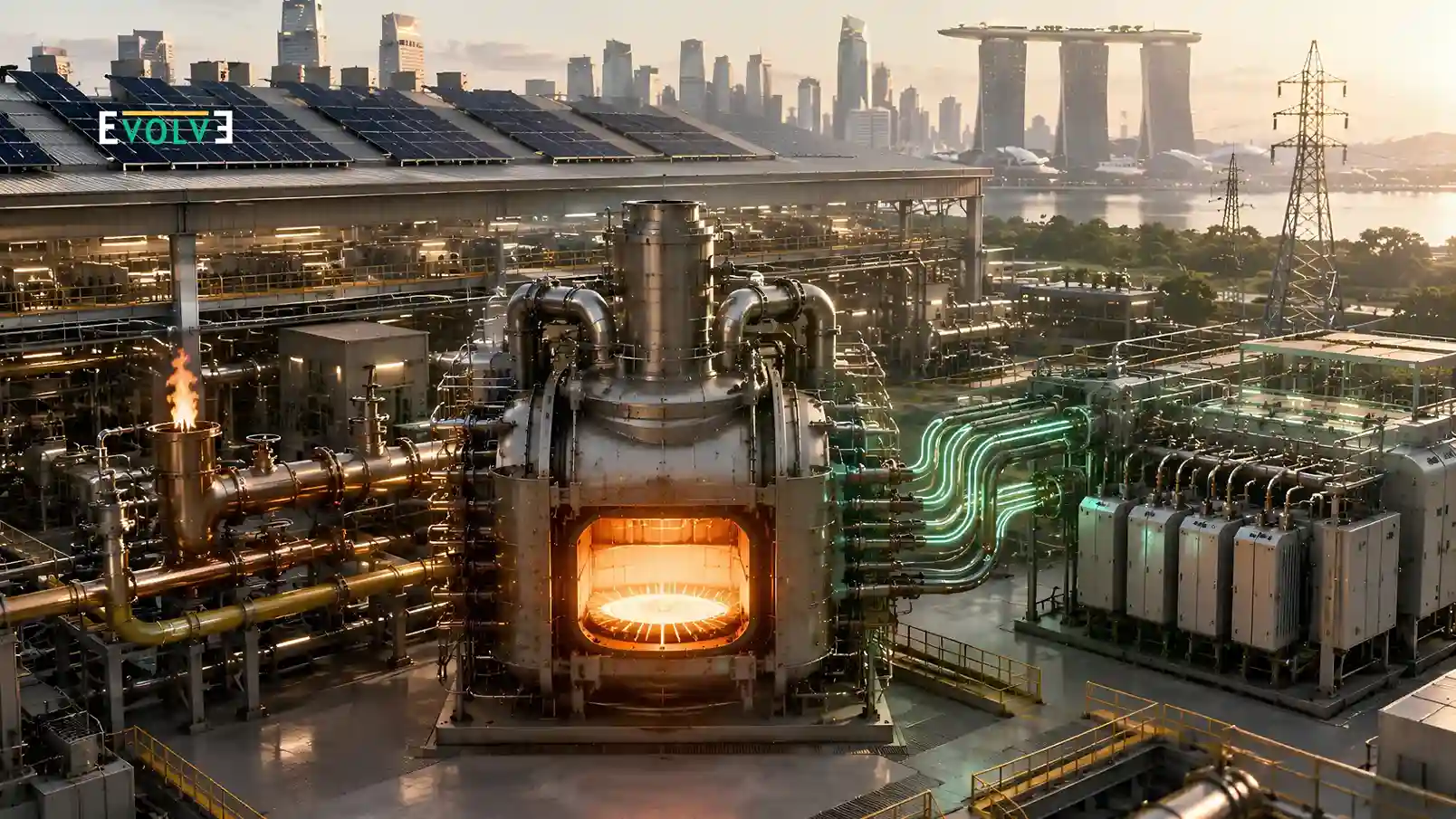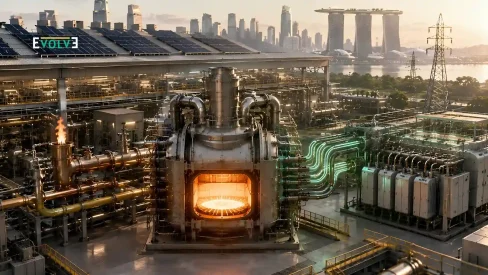
It has been doing this since 1987. It will keep doing this until someone brings it an alternative that costs less to operate, carries lower regulatory risk, and doesn’t require a complete redesign of its production process.
The Problem: 25% of Global Emissions Nobody Talks About
Industrial heat is different.
Decarbonising industrial heat is, on a pure emissions basis, one of the highest-impact interventions available in the climate tech landscape. It is also one of the most technically complex — which is why it has attracted a fraction of the capital that has flowed into power generation and transport electrification.
That gap is now closing. And the investment opportunity in the gap is significant.
The Technology Has Arrived — But Not Uniformly
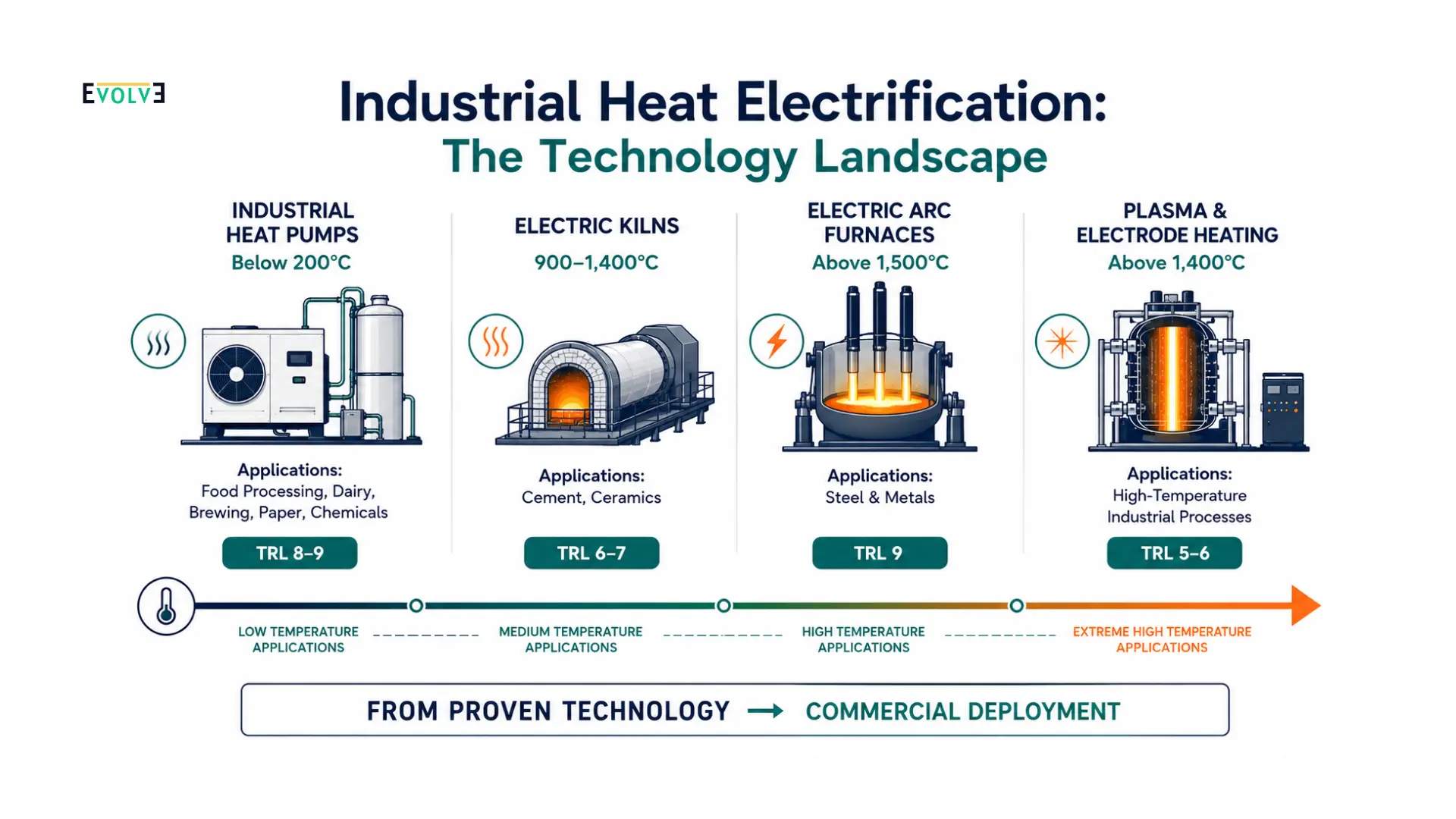
Industrial Heat Pumps — Below 200°C (TRL 8–9)
Electric Arc Furnaces — Steel Above 1,500°C (TRL 9)
Electric arc furnaces for steel production are fully commercial, already accounting for approximately 28% of global steel production. The world’s largest steel producers — ArcelorMittal, SSAB, Tenaris — are investing in EAF transitions at scale.
In Southeast Asia, EAF adoption is accelerating in Vietnam and Indonesia, driven by scrap steel availability and corporate buyers in Europe requiring decarbonised steel supply chains as a procurement condition.
Capital implication: EAF transition in SEA is not a technology investment — it is infrastructure and project finance. The opportunity is in the enabling ecosystem: electricity supply agreements, scrap collection networks, and financing structures that make EAF transitions affordable for mid-sized steel producers.
Electric Kilns — Cement and Ceramics at 900–1,400°C (TRL 6–7)
Electric kilns for cement and ceramic production are the most commercially exciting frontier in industrial heat electrification. The technology has been demonstrated at pilot scale. Several companies in Europe and North America have completed TRL 6 demonstrations — proving electric kilns can reach temperatures required for cement clinker and ceramic firing.
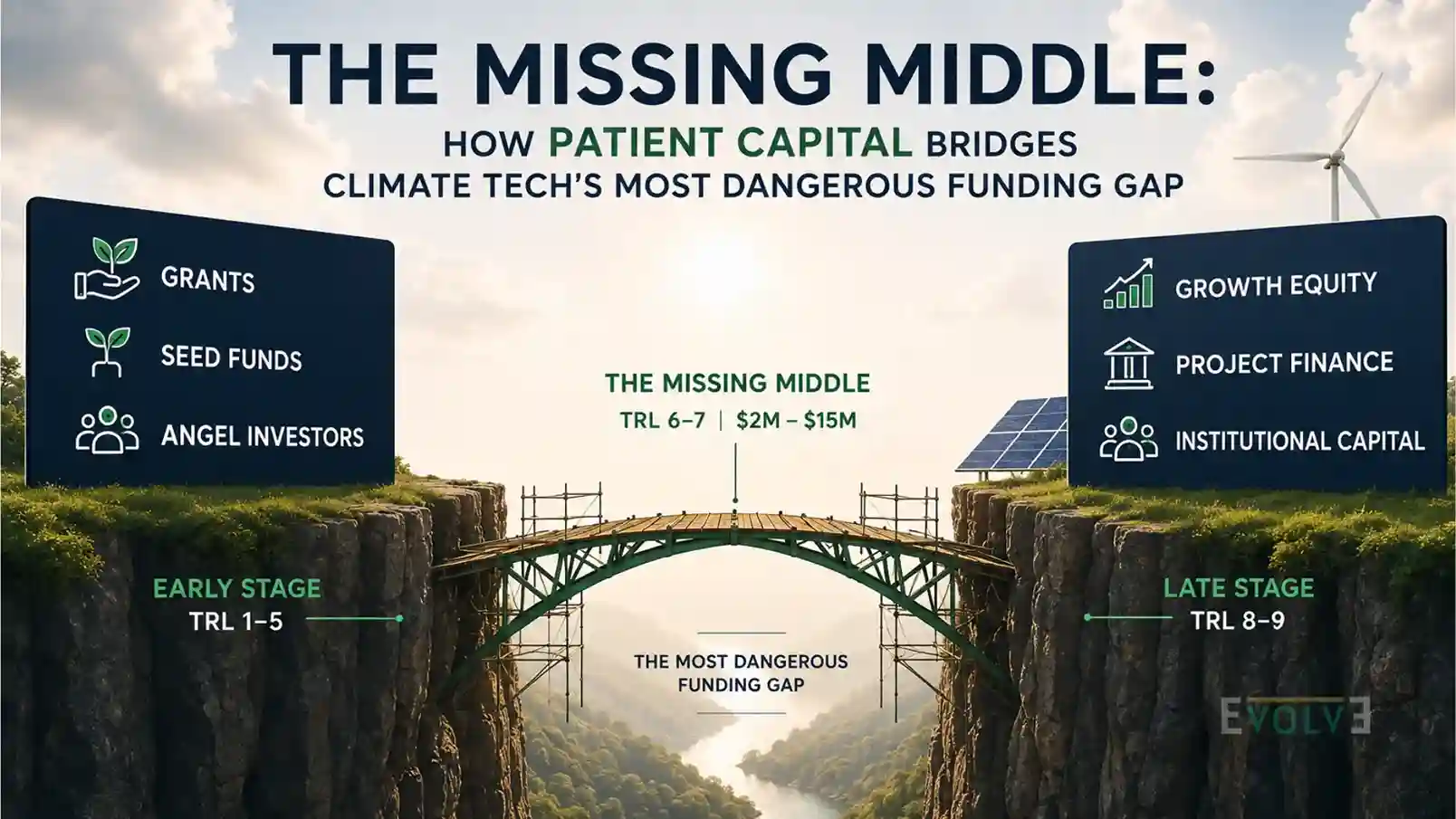
Full commercial deployment at TRL 8–9 has not yet been achieved at scale. The gap between successful pilot and first commercial installation is exactly the missing middle that patient capital is designed to bridge.
Capital implication: Electric kiln companies at TRL 6–7 are at the optimal entry point for patient capital with a 7–9 year hold horizon. Technology risk is substantially resolved. Commercial risk — the first full-size installation, replicability demonstration, first commercial contracts — is the risk patient capital is structured to absorb.
Plasma Furnaces and Electrode Heating — Above 1,400°C (TRL 5–6)
For the highest temperature applications, plasma furnaces and advanced electrode heating represent the frontier of electrification technology. Plasma-based steel and cement production has been demonstrated at lab and small pilot scale. Several well-funded startups in Sweden, Germany, and the US are advancing these technologies toward TRL 7.
Capital Implication: Early opportunities for deep technology funds that have greater investment periods and higher technical risk tolerance. This is the pipeline that will produce TRL 6 investments in Evolve Venture Capital’s sweet spot during the period of 2028 to 2032.
The Economics Are Turning
Industrial heat electrification has historically faced one fundamental barrier: electricity costs more than natural gas per unit of energy. Three forces are now changing this simultaneously.
Renewable electricity costs are falling. In Southeast Asia, utility-scale solar electricity is below $0.03/kWh in the best-resourced markets. As industrial facilities access power purchase agreements for renewable electricity, the cost of electrical heat generation moves toward parity with fossil fuel alternatives.
Carbon costs are rising for fossil alternatives. The EU’s Carbon Border Adjustment Mechanism — entering full implementation in 2026 — applies a carbon cost to imports of steel, cement, aluminium, fertilisers, and hydrogen into the EU. For Southeast Asian manufacturers exporting to Europe, CBAM creates a direct financial cost for fossil-fuel-based production that electric alternatives avoid. CBAM is effectively an externally imposed carbon price on SEA industrial production — making electrification economics materially more attractive faster than domestic carbon pricing alone would have.
Equipment costs are declining. Industrial heat pump costs have fallen approximately 25–30% between 2020 and 2026 and are projected to fall a further 20–25% by 2030, following a learning curve similar to solar panels in the early 2010s.
The combination of falling electricity costs, rising carbon costs for fossil alternatives, and declining equipment prices means the total cost of ownership for electric heat is approaching parity across a growing range of industrial applications in Southeast Asia — particularly below 300°C.
The Southeast Asia Opportunity
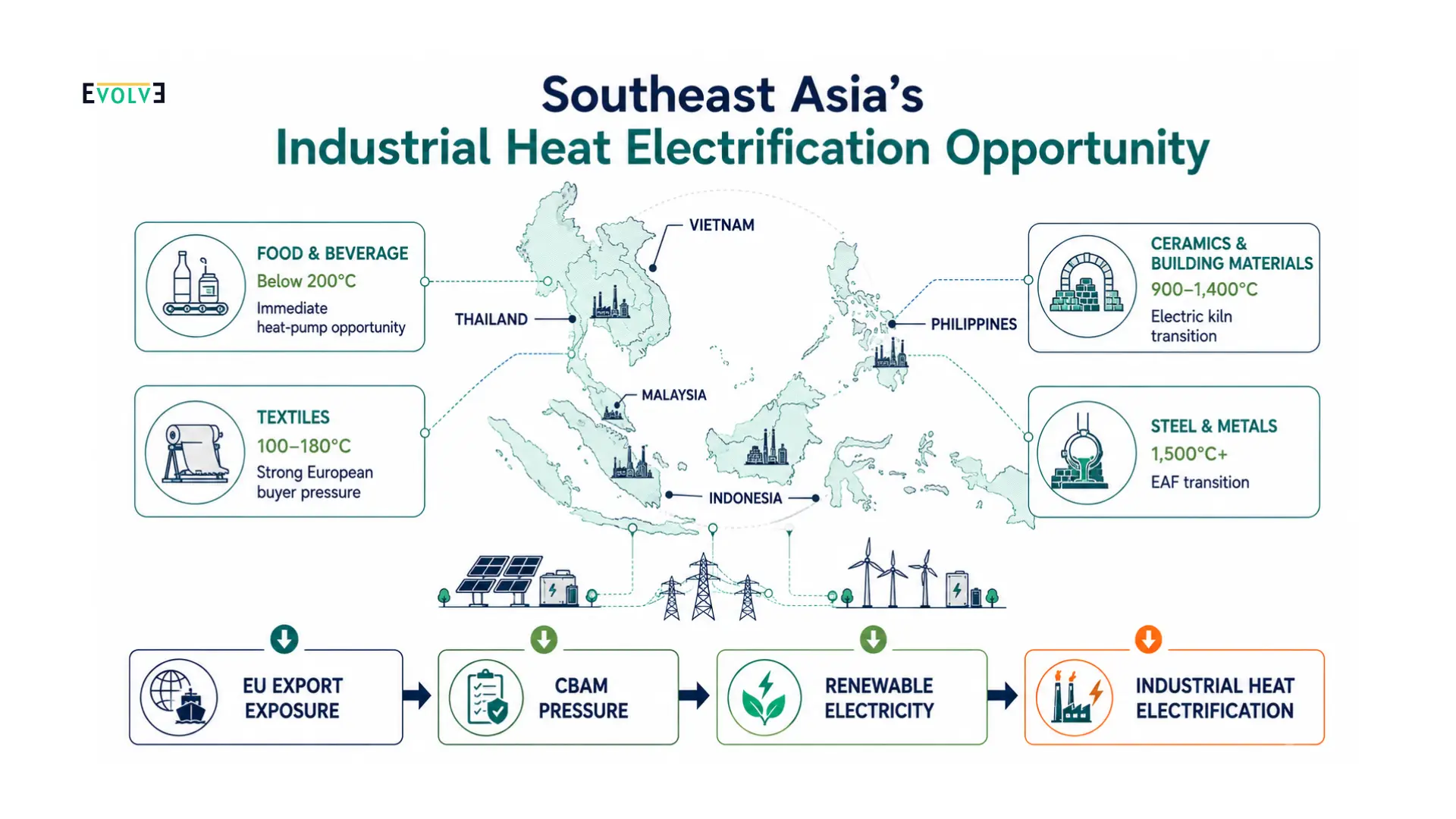
Southeast Asia is one of the world’s most important manufacturing regions. Vietnam, Indonesia, Thailand, Malaysia, and the Philippines are collectively home to major export manufacturing sectors in electronics, textiles, food processing, steel, cement, ceramics, and chemicals.
Two characteristics make industrial heat electrification particularly urgent in the region:
EU export exposure. A substantial amount of SEA’s manufactured goods ends up being sold to Europe – directly affected by the CBAM. The Vietnamese steel manufacturers, Indonesian cement manufacturers, and Thai chemical manufacturers all have European clients that demand carbon information and commitment as part of their contracts. Electrifying industrial heat processes is one of the most direct routes to reducing Scope 1 emissions and managing CBAM exposure.
Improving electricity infrastructure. Vietnam and Indonesia have significantly expanded renewable electricity generation. As PPAs for renewable electricity become more accessible to industrial customers, the carbon intensity of electric heat falls further — compounding the CBAM benefit.
The highest-priority SEA sectors:
- Food and beverage processing — widespread across the region, heat demand below 200°C, immediate commercial viability with industrial heat pumps at current electricity costs
- Textile dyeing and finishing — concentrated in Vietnam and Indonesia, strong European buyer pressure on Scope 1 emissions, 100–180°C range
- Ceramics and building materials — significant clusters in Indonesia, Vietnam, and Malaysia, at the electric kiln TRL 6–7 transition point
- Steel and metals — Indonesia and Vietnam, EAF transition driven by scrap availability and CBAM exposure on European exports
The Investment Landscape
Industrial heat electrification sits at an interesting point in the climate capital landscape: large enough to matter, complex enough to have been avoided, and early enough in commercial deployment that early-mover advantage is still available.
Current capital flows concentrate at early stage (deep tech R&D for high-temperature applications) and late stage (project finance for EAF transitions at large steel producers). The missing middle — commercial-scale deployment of proven industrial heat electrification technology at TRL 6–8 for mid-sized manufacturers — is underserved, creating a compelling opportunity within venture capital investment opportunities.
Typical investment opportunity at this stage:
- Deal size: $3–10 million equity at entry, with follow-on capacity of $8–20 million for commercial scale-up
- Structure: Equity with active board involvement, patient capital with 7–9 year hold horizon
- Value creation pathway: Technology validation → first commercial installation → reference site development → replication across manufacturing cluster → strategic exit
- Exit buyers: Industrial conglomerates building decarbonisation service capabilities, energy service companies expanding into industrial process heat, utilities seeking to extend customer relationships into industrial heat
What Evolve Venture Capital looks for at entry:
- Independent technical validation of performance data — not lab results, real manufacturing facility conditions
- At least one signed LOI or commercial contract at market rates
- Management team with direct industrial sector experience
- Clear replication pathway across multiple manufacturing customers
From Pilot to Profit: What the Transition Actually Looks Like
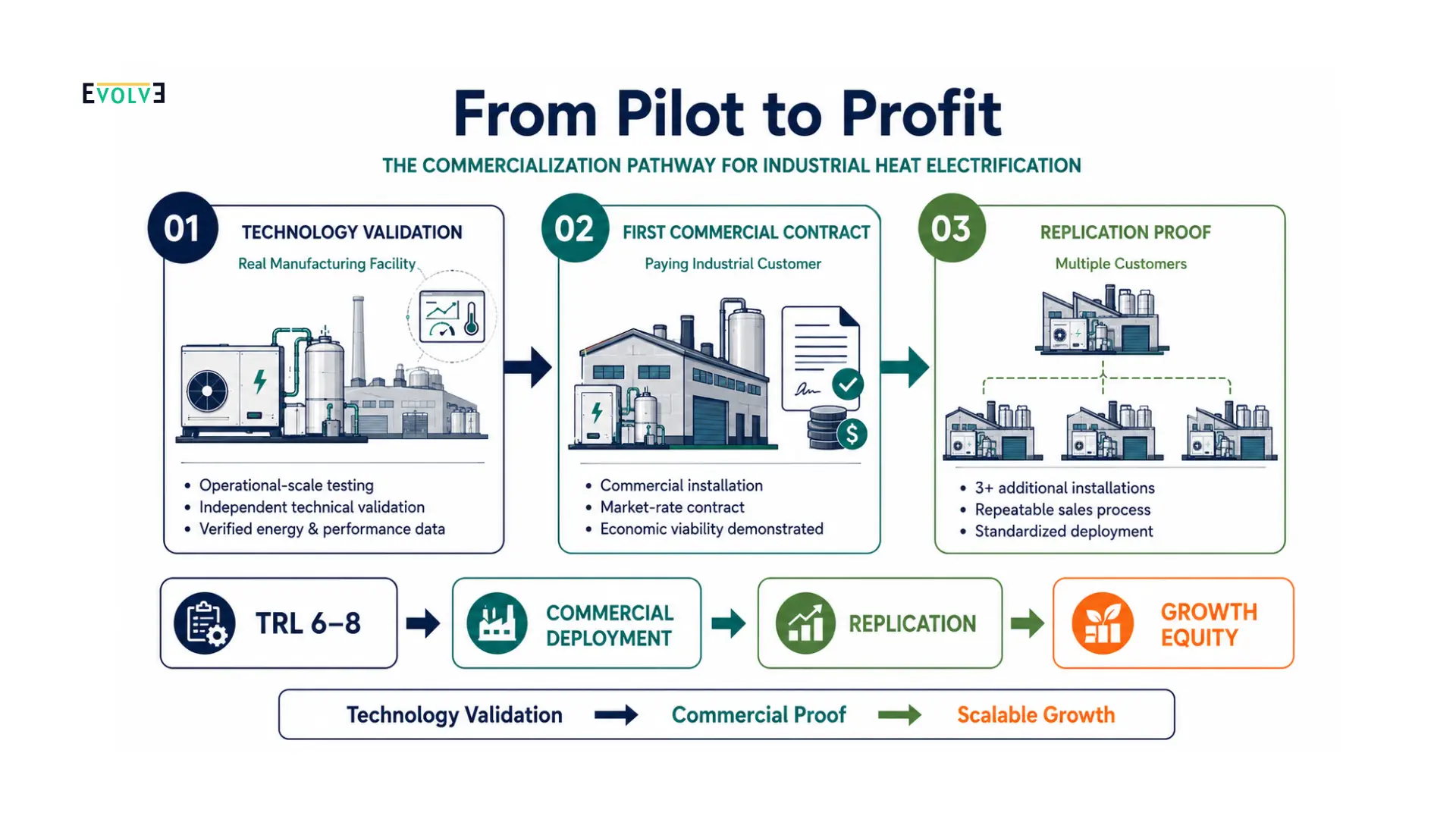
At Evolve Venture Capital, we track three specific milestones that signal successful commercial transition in industrial heat electrification:
Milestone 1 — Technology Validation. The solution has been independently tested at operational scale in a real manufacturing facility under real production conditions. Performance data is audited by independent technical review — energy consumption, heat output, process compatibility, and equipment reliability all confirmed.
Milestone 2 — First Commercial Contract. The company has signed its first commercial installation agreement with a paying industrial customer at market rates — not a subsidised pilot, not a grant-funded demonstration. The customer is paying because it makes economic sense for their operation.
Milestone 3 — Replication Proof. The company has successfully replicated the installation across at least three additional customers, demonstrating the first contract was not an anomaly. The sales process is repeatable. The installation methodology is standardised.
Companies at Milestone 1 working toward Milestone 2 are at Evolve Venture Capital’s optimal entry point. Companies at all three milestones are ready for growth equity.
The typical timeline from Milestone 1 to Milestone 3 in industrial heat electrification is 3–5 years — consistent with the commercial scale-up timelines we model for our 7–9 year hold structure.
If you are building an industrial heat electrification company and are approaching commercial deployment, contact Evolve Venture Capital to discuss your investment opportunity.
Frequently Asked Questions
What is industrial heat electrification?
Industrial heat electrification is the replacement of fossil fuel combustion with electrical energy to generate process heat required in manufacturing. Solutions include industrial heat pumps (below 200°C), electric arc furnaces (steel, above 1,500°C), electric kilns (cement and ceramics, 900–1,400°C), and plasma furnaces for the highest temperature applications.
How large is the industrial heat electrification market?
Industrial process heat represents approximately 20–25% of global final energy consumption. Electrifying that demand represents a capital deployment opportunity estimated at $1.2 trillion globally through 2050, with Southeast Asia accounting for an estimated $80–120 billion of that total.
Why is industrial heat hard to decarbonise?
Three specific challenges: the high temperatures required (above 500°C) are difficult to achieve efficiently with current electrical technology; industrial customers have long equipment replacement cycles (15–25 years) that slow adoption; and electricity has historically cost more per unit of energy than natural gas.
What is CBAM and how does it affect Southeast Asian manufacturers?
The EU Carbon Border Adjustment Mechanism applies a carbon cost to imports of specified industrial products — steel, cement, aluminium, fertilisers, hydrogen — into the EU, based on the carbon intensity of their production. For SEA manufacturers exporting to Europe, CBAM creates a direct financial incentive to reduce production-related carbon emissions, including those from fossil fuel combustion for industrial heat.
What does Evolve Venture Capital look for in industrial heat electrification investments?
Evolve Venture Capital targets industrial heat electrification companies at TRL 6–8 — after successful pilot demonstration, before full commercial-scale deployment. Key requirements: independent technical validation, at least one verified LOI or commercial contract, a replication pathway across multiple manufacturing customers, and a management team with direct industrial sector experience.
Sources
- European Commission — Carbon Border Adjustment Mechanism (CBAM) — Full Implementation 2026 — https://taxation-customs.ec.europa.eu/carbon-border-adjustment-mechanism
- Evolve Venture Capital — Industrial Decarbonisation Investment Thesis — https://evolvevcap.com